
The latest Thrive by Five Index (2024) found that more than half (55%) of four- to five-year-olds attending early learning programmes nationally are not developmentally on track for school readiness. Research consistently shows that attendance at a poor-quality early learning programme does little to improve developmental outcomes.
In Knysna, access to ECD is not primarily constrained by the availability of centres, but by affordability and parental attitudes toward early learning — meaning the most pressing task is ensuring existing programmes deliver sufficient and consistent quality.
Yet, quality ECD improvement is not a simple exercise: it requires strengthening a delicate system in which centre leadership, practitioner capability, financial sustainability, nutrition, infrastructure, ongoing mentoring, and the local ecosystem must all work together.
KET’s model is place-based and systems-oriented. We do not deliver once-off training or isolated projects. We build relationships and deepen support over time. Our integrated Preschool Support Plan covers three interconnected pillars:
KET’s Integrated Support Model
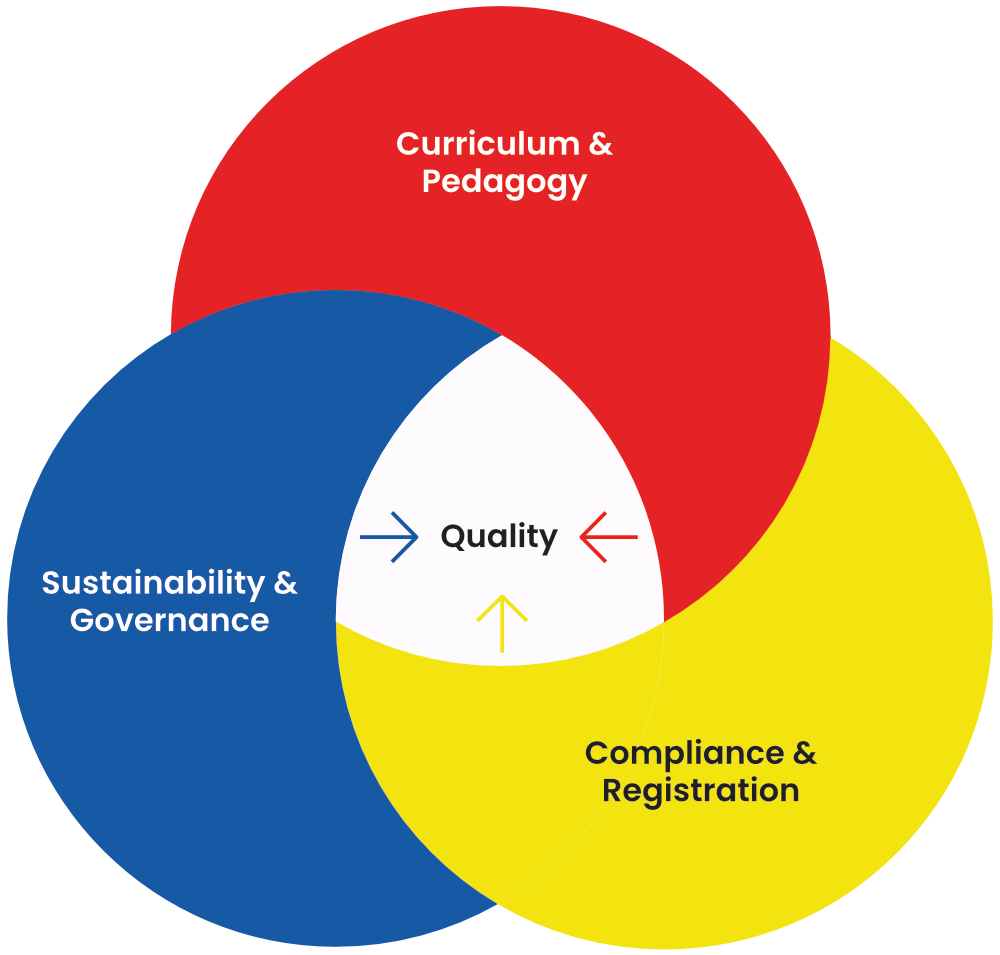
Curriculum &
Pedagogy
Further Education and Training in Early Childhood Development
KET supports professional growth in the ECD sector by offering access to NQF Level 1 and 4 qualifications in Early Childhood Development with bursary support where necessary.
Practitioner Training and Support
- A structured, 12 module training programme delivered through monthly workshops, focused on core ECD teaching and classroom management skills Specialised support for Grade R practitioners to ensure Grade Rs are ready for Grade 1
Daily ECD Programmes
- National Curriculum Framework (NCF) aligned daily programme for three-to-five-year-olds, including themed content and daily lesson plans
- Baby and Toddler programme (6-24 months)
- Integrated communication and support for parents
Ongoing, On-site Coaching, Mentorship and Monitoring
All partner sites benefit from regular visits by KET staff which provide monthly implementation/pedagogical support, continuous monitoring and practical assistance with quality assurance.
Catch-up for Developmental Delays
The Blocks for Growth programme provides targeted, group-based therapeutic intervention delivered by occupational therapists for four- to five-year-olds with developmental delays.
Compliance &
Registration
Government Compliance and Registration Support
KET is commissioned by the Western Cape Education Department to support early learning centres in Knysna and Bitou to meet the minimum norms and standards set out in the Children’s Act and ECD regulations. Support includes on-site compliance assessments, guidance on registration processes, training for principals and parent committees, and facility upgrade grants to address infrastructure gaps.
Sustainability &
Governance
Sustainability and Governance Support
- Training for parent committees and centre governing boards
- Small grants for facility upgrades and resources
- Fundraising support through participation in the Adopt a Centre for Excellence (ACE) programme
- Access to KET’s Feeding Scheme, ensuring nutritious daily meals
- Training and mentorship for centre Principals

Why Place Matters
Place-based means rooting early learning in the actual community where children live — in their language, their culture, their neighbourhood, and the real conditions of their lives. Research consistently shows that when ECD is grounded this way, both developmental outcomes and the long-term sustainability of programmes improve. It also shows that no single service — not health, not education, not nutrition, not social support — is enough on its own. Children’s development is driven by these services working together, in the same place, around the same child.
But this kind of coordination rarely happens by itself. Different organisations work to different mandates, in different sectors, on different timelines. Without someone holding the connections — convening, translating, and weaving — the ecosystem stays fragmented, and children fall through the gaps. That is the work KET does. We are a weaver of Knysna’s early childhood ecosystem — connecting people, organisations, and resources across the full system so that what is already happening locally can hold together and grow. For example:
- Early years to school readiness: KET prepares children for school. Our partner KILT (Knysna Initiative for Learning and Teaching) supports the public schools they enter afterwards — so children are carried by a connected system, not a series of disconnected stops.
- Government partnerships: KET is the Western Cape Education Department’s partner for ECD registration in the Knysna Municipality, helping centres register and access government funding. We also work with the Department of Health on a dental care initiative — bringing toothbrushes, toothpaste, and check-ups into ECD centres alongside early learning.
- We are beginning to build the two-way referral pathways between ECD practitioners, community health workers, and local clinics that the Nurturing Care Framework calls for — but that rarely exists in practice.
- Civil society and business partnerships: Businesses, non-profits, the Knysna Rotary Club, and faith-based organisations already support ECD centres in many quiet ways. KET works to strengthen and coordinate that support — reducing costs, building social networks, and helping centres find the partners they need. We are also piloting a volunteer board matching initiative, connecting ECD centres to people with the networks, resources, and influence to help them thrive.
- National connections: Beyond Knysna, KET partners with organisations like SmartStart and DataDrive2030 — because lasting change requires policy and systems reform that is grounded in strong data and real, on-the-ground experience.