It is not about expensive toys or fancy classrooms. It is about intentional learning: knowing what you want children to develop, and using your time, space, and activities to help that happen.
A quality programme has four ingredients:
- A curriculum framework that guides what children learn. In South Africa, most centres follow the National Curriculum Framework (NCF) for children from birth to four years, and the CAPS Grade R curriculum for five-to six-year-olds.
- A daily routine that gives children rhythm and predictability.
- Lesson plans that bring the curriculum to life through play, songs, stories, and activities.
- A way to track progress so you know each child is growing — and can spot early when extra support is needed.
When these four work together, you have a quality programme.
Daily routine
A daily routine is the rhythm of your day. It is when children arrive, eat, play, learn, rest, and go home.
Why it matters: Children feel safest when they know what comes next. A good routine reduces tears, tantrums, and confusion. It also helps staff stay calm and organised.
Example daily routine poster (right click to save)

Tips for a good routine
- Display it on the wall — with pictures for young children.
- Keep it the same most days. Children love predictability.
- Build in transitions (e.g. a song to signal pack-away time).
- Adjust for age — babies and toddlers need shorter, gentler routines than preschoolers.
Read more: Creating your daily routine

Lesson plans
A lesson plan is your roadmap for the week. It tells you and your team what you are going to teach, how, and why.
A good lesson plan includes:
- The theme for the week (e.g. My family, Animals on the farm, Things that fly).
- Learning goals — what you want children to know or be able to do by the end of the week.
- Activities for each learning area: literacy, numeracy, life skills, creative arts, physical development.
- Materials needed — books, songs, recyclables, outdoor equipment.
- A reflection space — what worked, what didn’t, what to try again.
Read more: Lesson planning made simple
However, you do not have to write lesson plans from scratch (unless you want to). Many resources and ready-made NCF aligned lessons are freely available (see below).
Free Lesson Plan Resources
Giraffe – App based Curriculum and Teacher’s Guide
Storybooks in many African languages, free to read, download, or adapt for your centre.
ECD practitioner App — lesson resources, planning tools, progress tracking.
Tools and resources for ECD practitioners
Masikhule’s online ECD Resource platform
Free stories in all SA languages to be used online or downloaded
Free literacy programmes: Little Stars (4–5 years), Stellar (5–6 years), plus parent resources
Free online play-based learning course from the Department of Basic Education.
Free children’s books in multiple SA languages. Download or print.
EAT LOVE PLAY TALK Caregiver Nutrition Programme
How do we see progress?
You see progress when you watch closely and write things down.
A child who could not hold a crayon in February is drawing circles by May. A child who would not speak in front of the group is now leading a song. These are the moments that show your programme is working — but only if someone notices and records them.
Three simple ways to track progress:
- Observation notebooks. Keep a small notebook per class. Each week, write a short note for each child — what they did, said, learned, struggled with.
- Termly checklists. Use a simple developmental checklist for each age group. Tick off skills as they emerge: walking, talking, counting, sharing, holding a pencil, recognising letters.
- Work portfolios. Keep a folder for each child with samples of their drawings, writing, and craft. Date everything. The folder tells a story over the year.
Share progress with parents. Have a short feedback meeting once a term. Bring the portfolio. Show the parent what their child can do — and what you are working on next. Parents who see real growth in their child stay, pay, and recommend you.
Watch for red flags. If a child is far behind their age group in talking, hearing, walking, or behaviour — speak to the parent kindly and suggest professional assessment (clinic, audiologist, speech therapist, occupational therapist). Early help changes lives.
Free tools that help:
- Grow ECD Learner Assessment Scoresheets — free, age-group-specific, NCF-aligned. Download and print from their Resource Centre.
- Road to Health Booklet — every child already has one from the clinic. It includes simple milestone checklists. Use it at parent meetings.
Nutrition and feeding
What children eat at your centre affects how they grow, how well they concentrate and how often they get sick. For many children, the meals at preschool are the most reliable food of their day.
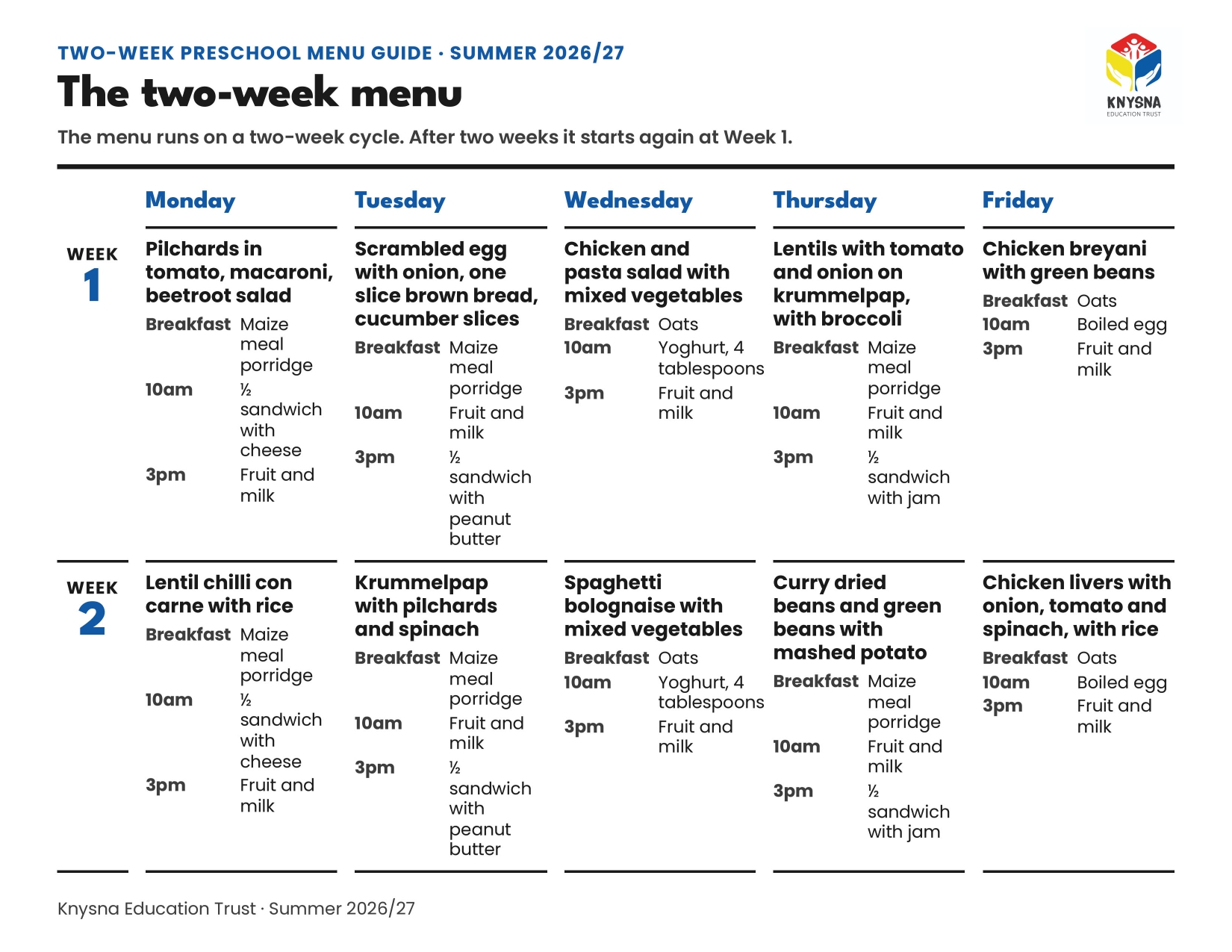
KET’s feeding scheme runs on a two-week menu. A nutritionist reviewed every meal and every portion. We’re sharing it so every centre can use it, not only the centres in our feeding scheme.
The menu gives breakfast, lunch and two snacks every day. It’s built around five things young children need: protein for growth, plant protein at least twice a week, iron from dark green vegetables and liver, colourful vegetables and fruit for vitamin A, and starch for energy.
Two-Week Preschool Menu Guide: the full menu and the thinking behind it, a recipe for every lunch (each makes 20 portions), a costed shopping list, and what to keep first if you can’t afford all of it.
Two-week Menu Poster: print for your kitchen wall.